 agshya
Whoa! The ecosystem keeps splintering. Many users want a single wallet that talks to Ethereum, BSC, Arbitrum, Polygon, and a handful of experimental L2s. That desire is obvious: convenience saves time and reduces friction when switching networks on the fly. But convenience often hides complexity, and that’s where things get interesting — and a little scary.
Seriously? Yes. At first glance, a multi-chain browser-extension wallet looks like a magic remote for DeFi. Initially it seemed that aggregating keys under one extension would simplify key management and reduce mistakes. Actually, wait—let me rephrase that: consolidation reduces the number of places you forget a seed phrase, though it can concentrate risk if the extension has a bug or a malicious update. On one hand this centralization feels handy; on the other, it concentrates blast radius when things go wrong.
Hmm… This article walks through the tradeoffs. It is aimed at users who use browser-extension wallets for daily DeFi interactions and want to understand security, UX, and practical operational patterns. No fluff. The guidance is practical, grounded in how extensions behave today and what design patterns mitigate common risks. Along the way there are honest caveats: somethin’ may still break, and nothing is perfectly safe.
Short primer: a browser-extension wallet stores private keys locally in the browser’s extension storage, typically encrypted with a password. That model keeps keys on your device instead of on a server, which is a big win for privacy and control. But “locally” isn’t a panacea; browser processes, other extensions, or OS-level malware can still interact with extension resources. So the threat model shifts — browser security matters a lot, and endpoint hygiene becomes central.
What “multi-chain” actually means for a browser extension
Short answer: network awareness plus RPC management. A multi-chain extension exposes multiple network RPC endpoints, token lists, and sometimes different signing logic for EIP-1559 vs legacy transactions. It also often includes built-in token detection, swap UIs, and cross-chain bridges. That breadth gives users convenience: token balances across networks in one place, cross-chain swaps without juggling wallets, and faster onboarding for new chains.
But here’s what bugs me about broad feature sets: every added capability increases the attack surface. More code paths. More external dependencies. And more places for subtle bugs to hide. My instinct said “more features = better UX”, though actually the math is more nuanced: helpful features must be balanced against rigorous isolation and audit hygiene. On the other hand, smaller wallets with fewer integrations sometimes offer a tighter security posture, but they inconvenience power users.
For pragmatic users, a compromise is to pick a wallet that provides clear isolation between accounts and networks, has frequent, transparent audits, and supports hardware wallets. A healthy sign is native support for hardware signing via WebHID/WebUSB or through integration layers like Ledger Live. Another positive signal is a clear changelog and opt-in features rather than forced updates that change signing behavior unexpectedly.
Security tradeoffs: convenience vs blast radius
Really? Yes—that tradeoff shows up everywhere. Convenience features like “one-click contract approvals” and in-wallet swaps are delightful, until a malicious contract is approved or a swap interface is spoofed. Wallets that try to be helpful may auto-detect a token and present a “Add token” button, and that UX nudge can lead to social-engineered approvals. So caution is warranted: always check the contract address and the approval scope.
Initially it seemed that the browser’s extension sandbox would stop most cross-extension threats, but modern attacks have proven otherwise. Browser extensions can be updated; some have had malicious or buggy updates pushed to users before maintainers could react. That means the update model and publisher reputation matter almost as much as the original code quality. Users should favor extensions with multi-party audits, bug bounty programs, and an active security-community dialogue.
For multi-chain wallets, one particular risk is misrouted RPCs. If an extension allows adding custom RPC endpoints, a malicious actor could entice users to switch to a compromised endpoint that serves manipulated states or transaction history. The wallet UI should clearly label custom endpoints and show warnings when signing requests originate from unfamiliar networks. Fancy UX is nice, but explicit user prompts and contextual warnings are very useful in practice.
Operational best practices (practical, not theoretical)
Here’s the thing. Keep at least two wallets: a hot wallet for small, daily interactions, and a cold or hardware-backed wallet for larger holdings. That’s basic compartmentalization — reduce exposure by limiting the amount at risk in frequent-use accounts. Also, set approval limits where possible and use “revoke” tools periodically to clear token allowances. It sounds tedious, but those small steps cut many common DeFi theft vectors.
Use hardware wallets when interacting with high-value contracts. Many browser-extension wallets support connecting a Ledger or similar device. That integration increases security because the private key never leaves the secure element; the extension simply forwards signing requests. Again, it’s not perfect: phishing UIs can still trick users into signing harmful transactions, but hardware devices add an explicit step that encourages a closer inspection before approval.
Keep the browser profile lean. Avoid installing dozens of extensions alongside your wallet. Each additional extension is a possible route for credential exfiltration or UI spoofing. Consider a dedicated browser profile or even a dedicated browser entirely for crypto activity. It feels extreme to some, but for active DeFi traders it’s a small cost that dramatically lowers everyday risk.
Choosing a wallet: signals to look for
Look beyond marketing. Check for audits from reputable firms, a public bug bounty presence, and a changelog that shows responsible disclosure and rapid fixes. Community trust matters: active Github issues, open-source components, and transparent governance threads are useful indicators. Also, see how the wallet handles network additions—are RPCs clearly labeled? Is custom RPC usage separated from recommended, vetted endpoints?
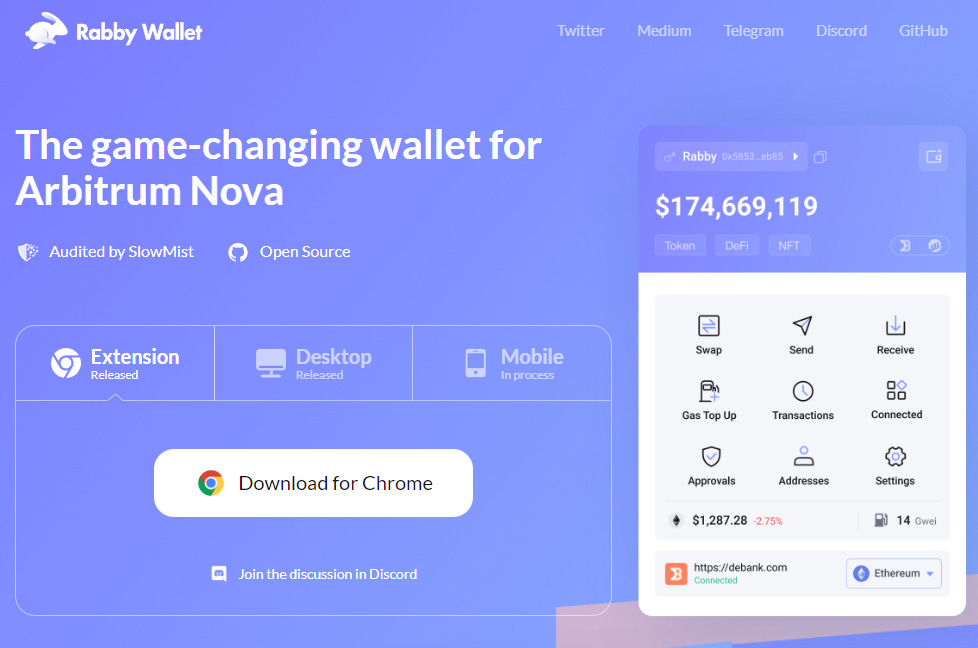
One practical option that many users evaluate for multi-chain browser-extension needs is rabby wallet. It presents a clean multi-chain UX and emphasizes account isolation and hardware support. Explore its download page and documentation to see how it fits your workflow: rabby wallet. That single link will get you to the official download resource; always verify domain authenticity before installing.
Another signal is how a wallet handles permission granularity. Wallets that support “view-only” permissions, custom nonce management, or allow users to set explicit gas limits give more control to cautious users. Those controls are especially important when interacting with bridges or contract-heavy DeFi protocols where transaction parameters can be complex.
When multi-chain features help (and when they hurt)
They help when you need speed and a unified interface for monitoring. Traders, NFT collectors, and builders often prefer one cockpit. Multi-chain wallets reduce mental context switching and speed up routine flows. They can also reduce errors like sending tokens to the wrong chain address when networks look similar in other wallets.
They hurt when the wallet over-automates. Automated approvals, auto-connecting sites, or overly broad token-detection can nudge users into risky actions. Wallets should default to safer behaviors: require explicit approvals, minimize auto-connections, and offer clear “connected sites” lists that are easy to review and revoke. Unfortunately, many wallets prioritize smooth UX over conservative defaults, and that design decision can cost users dearly.
Frequently asked questions
Is a multi-chain browser extension less secure than separate wallets for each chain?
Not necessarily. Security depends on implementation, update governance, and user practices. A well-audited multi-chain wallet with hardware support and clear isolation can be safer than several poorly maintained single-chain wallets. Still, compartmentalization is a solid strategy: limit balance exposure in daily-use accounts and use hardware or cold storage for long-term holdings.
Should I allow custom RPCs?
Only when you trust the source. Custom RPCs are useful for devnets and new chains, but they can be misused to present false states or obscure malicious contracts. Prefer vetted endpoints, and treat any custom RPC as higher risk until you can verify it independently.
How often should I revoke approvals?
Regularly. Monthly or after major interactions is a practical cadence for many users. Tools exist that list token allowances and let you revoke them; make a habit of auditing approvals after big trades or bridge operations. It’s low-effort insurance against common DeFi drains.